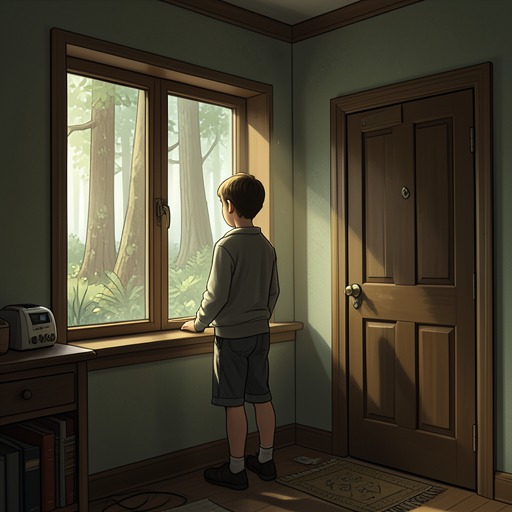
Handsome Laba
The Painted BirdHandsome Laba is Labina’s husband, a poor farmhand whose return after a year-long disappearance briefly appears to reverse his fortunes. He comes back bearing the signs of unexpected wealth, but the mystery of his absence remains unresolved, and his death follows the theft of the treasures he brought home. His story turns on the distance between what the village can see—his clothes, chest, and final loss—and what it cannot know about the life he led away from it.
Identity and Marriage
Before his disappearance, Handsome Laba was the poorest farmhand in the village, known for his good looks. Labina had once been a beautiful young woman courted by the richest peasants, yet she fell in love with him and married him despite the advice she received. Their match establishes a contrast between social standing and personal attachment: she chose the poor worker over wealthier suitors, and the narrative gives no indication that she later regretted that choice.
Labina’s memory of her husband is framed by absence. On rainy afternoons she becomes melancholy and speaks of him, though he is no longer alive. These recollections place their relationship in the aftermath of his disappearance and death: the reader encounters Laba through the story Labina preserves, while the central facts of his life beyond the village remain unknown. Her remembered attachment is also set against the village’s changing attention to him, which fades during the year he is gone.
Disappearance and Return
Handsome Laba leaves for the field one day and does not come home. He is still absent the next day and the day after that; the account offers no explanation for the departure, and no one is said to know where he has gone. His disappearance is presented as sudden and complete, with no intermediate account of travel or contact. The silence around those missing days becomes the defining gap in his biography.
A lonely year passes. The villagers forget Laba, but Labina continues to believe that he is alive and will return. Her expectation is vindicated one summer day, when a cart drawn by a fat horse emerges from the forest. A large chest, covered with cloth, lies on the cart; walking beside it is Laba, now wearing a fine leather jacket draped Hussar-fashion, expensive-looking trousers, and tall, shining boots. The return supplies a striking public image but no explanation: he has come back with property and changed appearance, yet the circumstances behind either remain concealed.
His arrival inside the hut intensifies that contrast. The crowd sees him in a lavish suit, a striped silk shirt with a white collar, a conspicuous tie, soft flannel, a satin handkerchief, black lacquered boots, and a gold watch. The careful inventory makes his new status legible through material things. The man remembered as the village’s poorest farmhand now appears surrounded by signs of abundance, but none of these objects tells the villagers how he acquired them.
The Chest and His Death
The chest links Laba’s unexplained past to the immediate circumstances of his death. After Labina rushes into the hut, she finds the attic door open and discovers that the chest has been emptied: its lid is torn off and its pale bottom exposed. Laba’s body is suspended above it by a floral-patterned necktie, while a hole in the roof marks the route by which the thief carried away the contents. The scene establishes a theft and a death, but does not identify the thief or explain exactly how Laba came to be hanging there.
The setting sharpens the loss without resolving it. The chest that arrived covered on a cart has become the most evident sign of what has disappeared; the opened roof connects the household interior to an unknown intruder’s passage. Laba’s display of wealth, so conspicuous at his return, ends with the goods gone and the chest left open. The story thus makes the cost of his new fortune visible only at the moment of its loss, while withholding any account of its origin or of the events that led to his death.
Unresolved Past and Narrative Significance
Labina never discovers how Laba acquired his treasures. He does not speak of the period when he was absent, and no one knows where he went, what he did, or what price he paid for the goods. These are not puzzles that the narrative later solves. Instead, the uncertainty remains part of Laba’s characterization: he returns transformed in outward appearance, but his inner history and the means of that transformation stay beyond the village’s reach.
The villagers know only the cost of losing the possessions. That final limit on their knowledge also governs the reader’s view of Laba. The story offers concrete evidence of poverty, separation, return, conspicuous wealth, theft, and death, but no secure explanation that joins them into a complete account of his life away from home. Labina’s belief that he would return is fulfilled, yet reunion does not restore him to her for long or disclose what happened during his absence. His return answers the question of whether he is alive, only to replace it with deeper questions about the fortune and loss that surround him.